
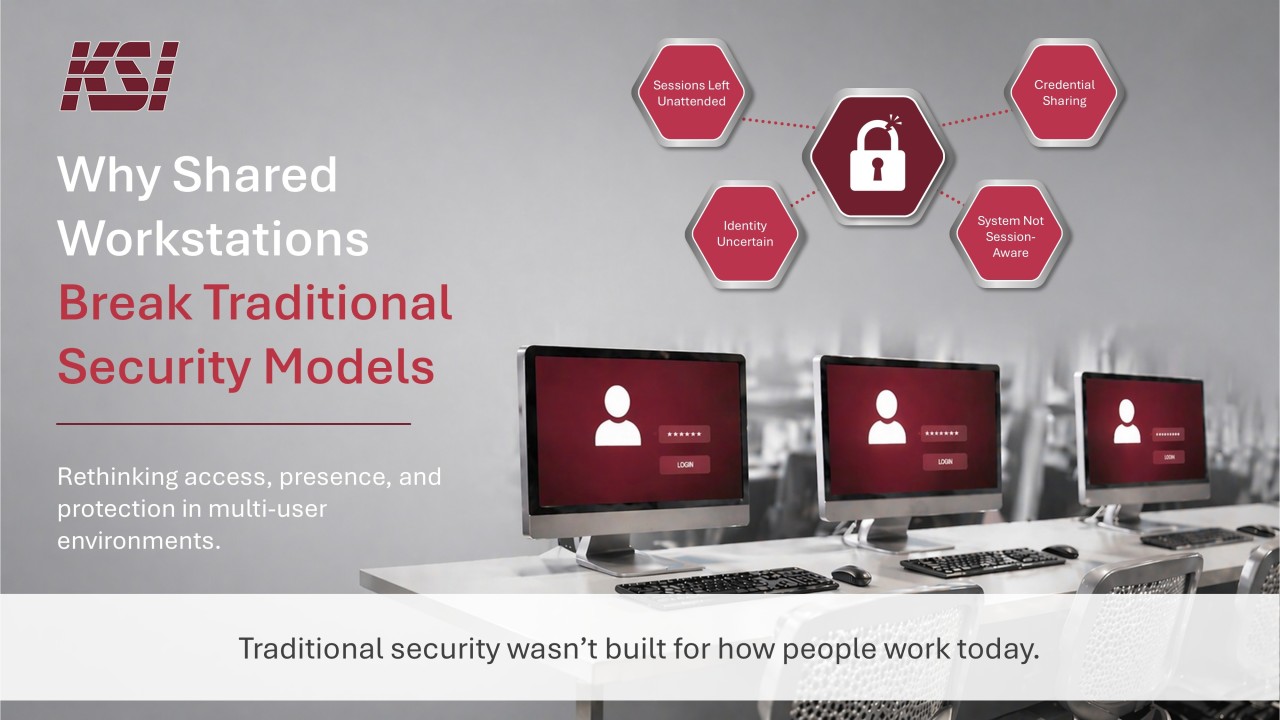


For years, the foundation of workplace security rested on a single, comfortable assumption: one employee, one device, one desk. In this traditional model, a worker logged in at 9:00 AM, remained at their station for hours, and signed out at the end of the day. The environment and process were linear and predictable, where security perimeters were easy to define.
In the modern landscape, that perimeter has dissolved. Across healthcare, manufacturing, corporate enterprise, financial services, and education, the “private desk” has been replaced by the shared workstation. Whether it’s a clinician rotating through hospital wards, production staff moving between manufacturing cells, or bank employees handing off secure systems during a shift change, the reality of work is now fluid.
This shift has created a dangerous friction point. While workflows have evolved to prioritize speed and continuity, our security models are often still stuck in the era of the stationary cubicle. When we apply yesterday’s assumptions to today’s shared environments, we don’t just create continued inconveniences — we create risky vulnerabilities.
The Breakdown of the Legacy Model
The cracks in traditional security become visible the moment a user steps away. In a fast-paced environment, sessions often stay open far longer than they should. A user logs in, is called away for an urgent task, and leaves behind an active window into sensitive data. In these short, unattended windows, the risk of unauthorized access or data exposure skyrockets.
Further, traditional most multifactor authentication deployments are designed solely for the moment of login. However, risk doesn’t end once the password is typed; it persists throughout the entire duration of the session. If an authenticated user walks away, the system remains “secure” by technical definition, even if the person currently standing in front of the screen is an unauthorized bystander or insider threat.
When security controls become a hurdle, human nature takes the path of least resistance. If a professional is forced to enter complex passwords dozens of times a day, password fatigue sets in. Password fatigue leads to the inevitable rise of workarounds: shared credentials, sticky notes taped to monitors, and the dangerous habit of leaving sessions unlocked to save time. In these scenarios, security that slows down the mission is security that gets bypassed.
A New Standard: From Login to Logoff – Full-Circle Security
To bridge this gap, organizations must move beyond the question of “Who logged in?” and begin asking a more critical question: “Who is present now?”
The future of access security lies in the transition from login security to session security., requiring a mindset shift where human presence itself becomes a security signal. By integrating technologies such as RFID credentials, fingerprint biometric authentication, the use of physical security keys, fast SSO workflows – and now human presence detection – organizations can create a full-circle “presence-aware” environment.
In this model, secure access becomes as fluid as the workflow. Security controls can automatically lock a station the moment a user moves out of range and instantly re-authenticate them the moment they return. This process eliminates the need for manual lockouts and cumbersome re-logins, removing the incentive for employees to bypass their own security protocols.
Security That Fits the Work
Ultimately, the strongest security controls are the ones that people can realistically use. Shared workstations do not have to be an inherent weakness. Instead, they represent an opportunity to build a more resilient, adaptive defense. Organizations that continue to apply single-user assumptions to multi-user environments are protecting a workplace that no longer exists. By embracing session-based security and presence-aware controls, we can ensure that security finally reflects how people actually work — protecting not just the moment of entry, but every moment that follows.