
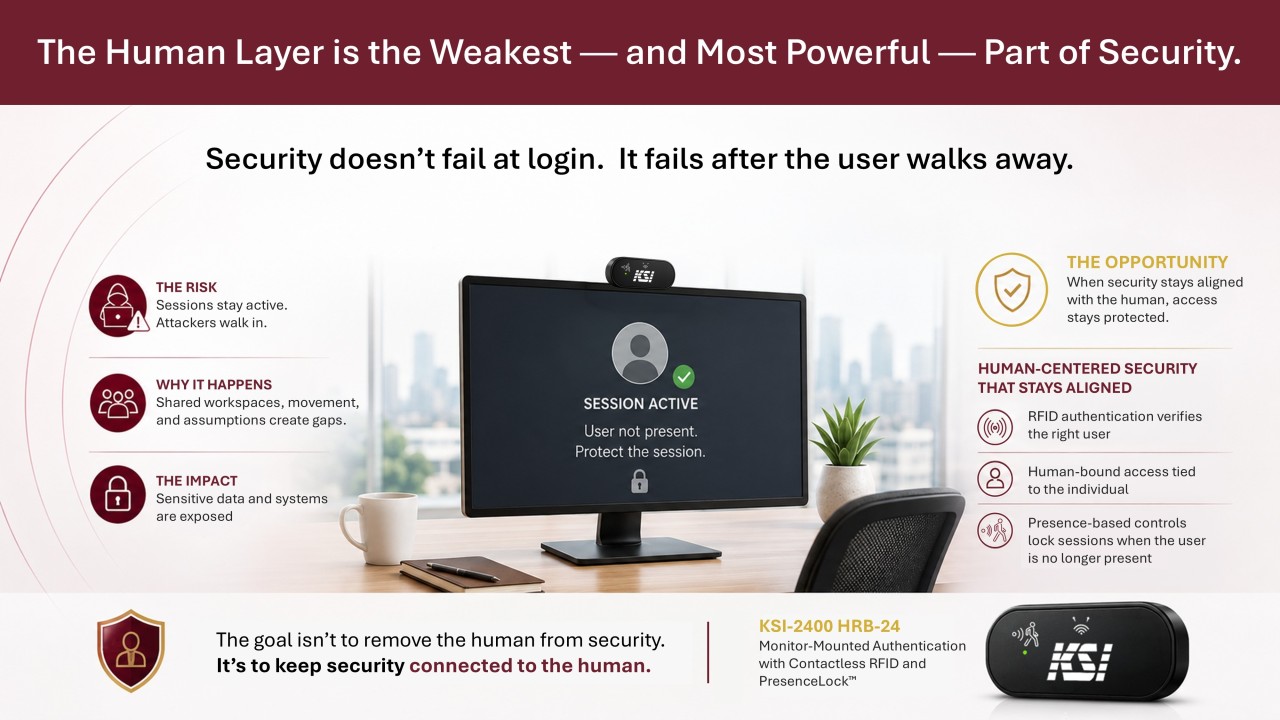


For years, cybersecurity has been framed primarily as a high-stakes technological arms race. Organizations have funneled billions into developing better tools, implementing stronger encryption, and deploying ever-more sophisticated detection algorithms.
Despite building formidable digital fortresses, breaches continue to follow a stubbornly familiar pattern. They occur not because the systems themselves fail, but because humans are inevitably involved in the process — not as a flaw in the system but as the primary entry point for modern threats.
Attackers Don’t Break In — They Log In
Most modern attacks no longer rely on hackers brute-forcing their way through hardened digital defenses. Instead, attacks exploit something much simpler and more accessible: the vulnerability of human credentials. By leveraging stolen passwords, reused login information, or trusted sessions left unattended, attackers aren’t forcing the door open — they are simply walking through legitimate access paths with a valid key. Once they have successfully authenticated, their movements within the network look entirely legitimate, allowing them to operate undetected within the heart of the organization.
The Human Layer is Where Risk Begins
Security teams often focus their energy on the moment of authentication, asking only if the right person provided the correct credentials to log in. A question just as critical for modern defense is whether that authorized individual is still the one sitting at the keyboard. This distinction is vital in dynamic environments where workstations are frequently shared, users move between desks, and sessions often persist long after active use has ended.
The human layer introduces a level of variability, driven by movement, distraction, and workflow interruptions, that traditional static security models often fail to account for.
Why the Human Layer is Also the Solution
While it’s easy to dismiss users as the “weakest link” in the security chain, that framing overlooks a fundamental truth: security cannot exist without the human element. Every meaningful action within an organization — whether it is accessing sensitive data, approving a financial transaction, or interacting with core systems — originates from a person. Consequently, the goal of a robust security strategy should not be to eliminate the human layer, but rather to anchor the entire security architecture to it.
What Effective Human-Centered Security Looks Like
To truly secure modern environments, organizations must move beyond the “checkpoint” mentality of one-time verification and transition toward a model of continuous alignment between the user and their session. This comprehensive approach includes:
- Hardware-Backed Authentication: Utilizing contactless RFID or NFC to replace passwords with physical, proximity-based credentials that ensure the user is the correct human at the workstation.
- Human-Bound Access: Access tied to the specific physical individual rather than just a set of transferable digital credentials.
- Real-Time Monitoring: A system that doesn’t just check who you are at login but confirms you are still there every second you are working.
- Elimination of Nonproductive Effort: Presence verification that happens passively in the background, removing the need for users to manually lock sessions during their shift.
- Presence-Based Controls: Implementing human presence detection that automatically locks a session when a user is no longer physically present, ensuring that security doesn’t rely on manual logouts that are prone to being missed.
By moving to a model of continuous presence validation, organizations can effectively eliminate the need for disruptive manual logouts.
The Shift From Solely Identity-Based Security to Include Presence
Traditional authentication is designed to answer a single question: “Who are you?” While that question remains critical, modern security requires answering a second, more persistent question: “Are you still there?”
The shift from solely identity-based security to include presence-based security addresses the gap where most attackers currently operate — inside trusted, hijacked, or abandoned sessions.
Conclusion
The human layer will always be an intrinsic part of the security landscape, serving as both a source of risk and the strongest possible signal of intent and legitimacy. The ultimate goal of modern defense is not to bypass the human, but to design systems that recognize human behavior, adapt to real-world workflows, and continuously verify presence rather than granting indefinite trust.
In today’s complex environments, security rarely fails at the moment of login; it fails the moment the authorized user walks away.
And in practice, this is where innovative solutions such as the KSI-2400 HRB-24, that combine contactless authentication with continuous presence detection, help align access with the actual user at the workstation.